
Versiti - Blood Types Explained | Versiti Blood Centers
Explore our service lines

Blood TypesExplained

Why are there different blood types? How can I learn my blood type?
From A to O, all your blood type questions answered.

Facts About Different Blood Types

Every year in the United States, 4.5 million lives are saved by blood transfusions from donors just like you. But do you know your blood type? Do you know where blood types come from? 

Learn more about how your blood type is determined; get fascinating facts about each blood type; and get answers and insights to some of the most frequently asked questions about blood types from our medical experts.

No matter what blood type you have – A positive, A negative, B positive, B negative, AB positive, AB negative, O positive, O negative, or a rare and uncommon blood type – we guarantee you’re someone’s type!

What Should I Donate?

Your blood type plays a big part in deciding what donation is the best fit for you. Choose your blood type from the options below to see the best fits.

A Blood Type

A+ Blood Donors

Male
Platelet, Whole Blood, Plasma, and Ro/Rare

Female
Platelet and Whole Blood

A- Blood Donors

Male
Platelet, Double Red, Whole Blood, and Plasma

Female
Platelet, Double Red, and Whole Blood

B Blood Type

Type B blood donor recommendations are the same for men and women.

B+ Blood Donors

Ro/Rare, Platelet, and Whole Blood

B- Blood Donors

Platelet, Double Red, and Whole Blood

AB Blood Type

AB+ Blood Donors

Male
Platelet, Plasma, and Whole Blood

Female
Platelet

AB- Blood Donors

Male
Platelet, Plasma, and Whole Blood

Female
Platelet and Whole Blood

O Blood Type

O+ Blood Donors

Male
Ro/Rare, Low Titer Whole Blood, Platelet, Double Red, and Whole Blood

Female
Ro/Rare, Double Red, Whole Blood, and Platelet

O- Blood Donors

Type O- blood donor recommendations are the same for men and women.

Neo Whole Blood, Double Red, Whole Blood, and Platelet

Blood Group Facts

Your blood type is more than a letter. It helps determine which patients you can help and, at times, which kind of donation can make the biggest difference. Every two seconds, someone in the U.S. needs blood, and one donation can help up to three patients. Whether you are A, B, AB, or O, your gift can support neighbors in our community through blood, platelets, or plasma. Explore your type to see how you can help.

A+ Blood Type

  • 30% of the population have A+ blood – the second-most common type, so your donations are always in demand
  • You can give blood to patients with types A+ and AB+
  • You can receive blood from A+, A-, O+ and O- donors
  • Men with A+ blood are a great candidate for platelet donations

A- Blood Type

  • Only 6% of the population have A- blood – a rare type, so your donations are always needed
  • You can give blood to patients with types A-, A+, AB- and AB+
  • You can receive blood from A- and O- donors

AB+ Blood Type

  • 4% of the population have AB+ blood – a rare type, so your donations are always needed
  • You can only give blood to patients with type AB+
  • You can receive blood from donors with any type
  • You are the universal plasma donor, who can donate plasma for patients of any blood type

A- Blood Type

  • 1% of the population have AB- blood – the least common type
  • You can give blood to patients with types AB- and AB+
  • You can receive blood from AB-, A-, B- and O- donors

B+ Blood Type

  • 9% of the population have B+ blood – a rare type, so your donations are always needed
  • You can give blood to patients with types B+ and AB+
  • You can receive blood from B+, B-, O+ and O- donors

B- Blood Type

  • 2% of the population have B- blood – a rare type, so your donations are always needed
  • You can give blood to patients with types B-, B+, AB- and AB+
  • You can only receive blood from B- and O- donors

O+ Blood Type

  • 39% of the population have O+ blood – the most common type
  • You can give blood to patients with any positive type
  • You can only receive blood from O+ and O- donors

O- Blood Type

  • 9% of the population have O- blood
  • You can give blood to patients of any blood type – you are the universal donor
  • You can only receive blood from O- donors
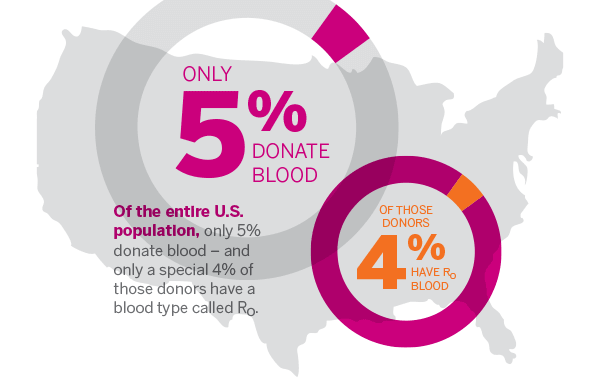
US Donation Population in comparison with those having Ro blood

Why is the Ro Blood Type So Important?

Of the entire U.S. population, only 5% donate blood—that’s less than the entire population of New York City. Of that small group of generous donors, only a fraction have a blood type called Ro. Ro donors have special markers on their red blood cells, and while this blood type is normal, it’s uncommon.

Learn More About Ro Blood Type
Lena Harvey

Lena's Story

I just want people to keep it in the right perspective and to consider how great their life could be, instead of focusing on how bad it was. I have lived that many times over, but we all deserve a chance at life.
Lena Harvey
Sickle Cell warrior and advocate.
Your blood is rare and exceptional graphic

What is Sickle Cell Disease?

Sickle cell disease (SCD) is aninherited disorder of hemoglobin. Individuals with sickle cell disease have abnormal, or 'sickle shaped', red blood cells. These cells cannot transport oxygen well, have a shorter lifespan and aren't replaced as quickly by the body as normal, healthy red blood cells.

This can cause anemia. Learn more about sickle cell disease by downloading the flyer below.

Download the Sickle Cell Disease Flyer