

History
Versiti Blood Research Institute (VBRI) sits at the forefront of scientific discovery and innovation in the field of blood and blood disorders. The breakthroughs that happen at VBRI in transfusion medicine, immunology, thrombosis, and hematology transform patient care throughout our home on the Milwaukee Regional Medical Center (MRMC) as well as across the globe. That dedication to world-class research has been baked into the mission since day one.
Advances in surgery and medicine post-World War II established the importance of blood transfusion and the need for a reliable blood supply. In 1946 in Milwaukee, the vision for a community-focused nonprofit blood center took shape between the Milwaukee County Medical Society and the Milwaukee Junior League. In the Junior League’s earliest documentation, it was noted that its mission was twofold: “supply blood and plasma to patients and promote research in the field of blood as well as engage in scientific activities and endeavors.”
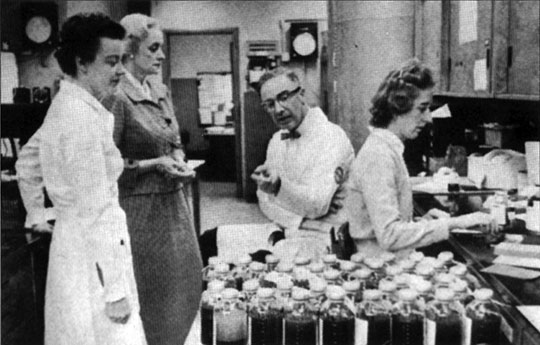
In 1947, Tibor “Tibi” Jack Greenwalt, a local internist, agreed to take on the role of medical director of the newly formed Junior League Blood Center. Dr. Greenwalt had trained in hematology and gained experience in transfusion medicine in Boston and NYC, which was unusual for an internist at the time. The future “Father of Transfusion Medicine,” Dr. Greenwalt would go on to be the founder of the Blood Center of Wisconsin, the founder and first member of the American Association of Blood Banks, founding editor of the journal Transfusion, founder of the AABB rare blood program (initially based at the Blood Center of Wisconsin), and much more.
Under Dr. Greenwalt’s leadership, these early years laid the groundwork for what would become an innovative hub in the region.
The 1960s and 70s marked a period of rapid growth in research efforts, including the founding of the Comprehensive Center for Bleeding Disorders. This clinical-research partnership continues to provide world-class care for people facing hemophilia and other rare blood disorders.
Richard H. Aster, MD, joined the Blood Center as executive director in 1970, later becoming its president in 1975. He’d previously done a fellowship at the National Institute of Health and served as a full-time member of the Harvard Medical School faculty.
Today a senior investigator, Dr. Aster has published approximately 400 peer-reviewed papers, co-founded the Great Lakes Hemophilia Foundation, and greatly contributed to thrombocytopenia diagnosis and treatment.
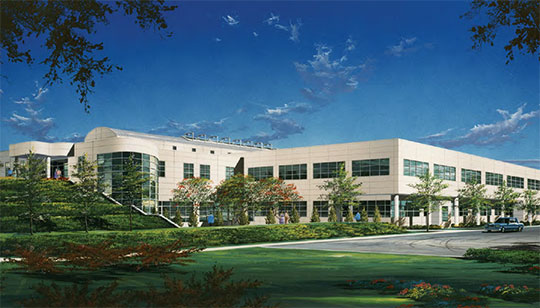
The 1980s were transformative, culminating in the groundbreaking of the Blood Research Institute building within the Milwaukee Regional Medical Center in 1989. It wasn’t just that our scientists contributed to life-saving breakthroughs for patients worldwide, though they did that, too, but this was truly the decade where we stepped into our role as a leader in blood research. This included co-founding the National Marrow Donor Program and being awarded the first National Heart, Lung and Blood Institute research grant to study HIV/AIDs in hemophilia patients.
With the completed construction of the Blood Research Institute, the Blood Center of Wisconsin officially moved its research functions from its headquarters on the corner of 18th Street and Wisconsin Avenue to join the Milwaukee Regional Medical Center (MRMC) in 1991, solidifying our place in the region as a significant partner in blood research and health care.
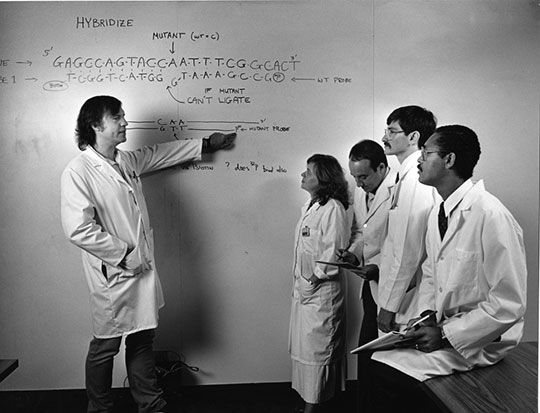
The Blood Research Institute pushed the boundaries of blood disorders and cancer treatments even further, making deep inroads into molecular science.
In 2000, Dr. Bill Cashdollar joined the Blood Research Institute to manage the Research Core Laboratories, which provide research services as well as cutting-edge instruments and technology that would normally be unavailable to independent labs. Dr. Cashdollar’s leadership bolstered the Blood Research Institute’s identity as a place for scientific collaboration.
By 2010, we expanded to include Wisconsin Donor Network, Wisconsin Tissue Bank, and the Medical Sciences Institute. A year later, the Adult Sickle Cell Clinic – the only one of its kind in Wisconsin – was established. This wide, comprehensive range of lifesaving services, all contained within one unified organization, was and remains truly unique. At last, in 2019, the Blood Center of Wisconsin transformed into a five-state nonprofit organization with blood centers also in Illinois, Indiana, Michigan, and Ohio. Together, they formed Versiti.
Today, Versiti Blood Research Institute is home to more than 30 principal investigators who are conducting cutting-edge research in immunology, hematology, and cell and gene therapy. Plus, even more is on the horizon with a 79,000-square-foot building expansion set for completion by the end of 2026. Increasing the size of VBRI’s footprint will bring with it collaboration spaces, state-of-the-art facilities, and more investigators, scientists, and students. The positive ripple effect for health care at large, as well as patients and their families, will be truly monumental.
From its pioneering work in transfusion medicine to its current role driving innovation in cellular and genetic therapies, VBRI remains committed to its earliest mission: transform the lives of patients through innovation and hope.
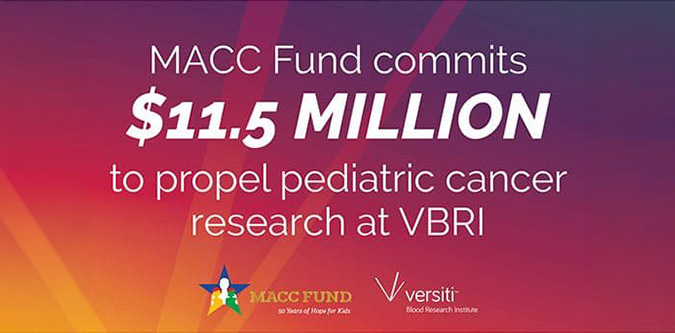
The MACC Fund has committed $11.5 million to advance pediatric cancer research at the Versiti Blood Research Institute, strengthening a long-standing partnership dedicated to improving outcomes for children facing leukemia and other blood disorders.
A Nature Communications study led by Prithu Sundd, PhD, shows how a CD39 gene variant may raise lung thrombosis risk in sickle cell disease and could help guide future precision therapies.

Eight Versiti Blood Research Institute scientists earned spots on Stanford and Elsevier’s World’s Top 2% Scientists list in the latest update—showing their hematology research is shaping science and patient care worldwide. Meet the investigators behind the impact.