Versiti - Bonnie N. Dittel, PhD | Versiti Blood Research Institute
Bonnie N.

Dittel, PhD

Senior Investigator

Hematopoiesis and Immunology

Senior Investigator

Dr. Gilbert C. White II Endowed Faculty Chair

Professor, Department of Microbiology & Immunology, Medical College of Wisconsin

Education and Training

Postdoctoral Training, Yale University

Doctoral Training, University of Minnesota, Ph.D., 1994
Contact
Social LinkedIn

Current Research Interests

The focus of our research program is to investigate cellular and molecular mechanisms involved in the regulation of inflammation. Inflammation is a component of virtually every disease and if not controlled can lead to severe tissue damage. The primary disease model utilized in the laboratory is the mouse model of multiple sclerosis (MS), experimental autoimmune encephalomyelitis (EAE). MS is an autoimmune disorder of the central nervous system (CNS) and is characterized by focal areas of inflammation. In past studies, we have extensively utilized EAE to study negative immune regulatory mechanisms that keep inflammation in check within the CNS. Our current studies have expanded to mouse models of contact dermatitis (contact hypersensitivity) and inflammatory bowel disease (DSS-colitis).

B Cell IgD Low (BDL) Regulatory B Cells

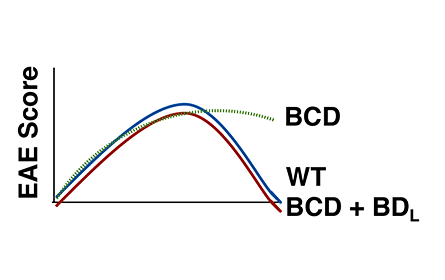
B cell regulation of autoimmunity was first demonstrated by us in the EAE model, whereby B cell deficient (BCD) mice were unable to recover from the clinical signs of EAE.

Illustration of EAE Disease

Figure 1: An illustration of EAE disease in B cell deficient (BCD) mice. BCD mice (green dotted line) do not recover from the signs of EAE like their wild-type (WT (solid blue line)) counterparts. When BCD mice are adoptively transferred BDL (red line) prior to EAE induction, the mice undergo recovery similar to WT mice.

Thus, our findings indicate that BDL play an essential role in Treg homeostasis whereby they maintain Treg numbers at a sufficient level to dampen inflammation. Current studies are investigating the development, phenotype and localization of this novel subset of regulatory B cells. These studies are being advanced using single cell RNA sequencing (scRNAseq), which we are utilizing to further define the BDL subset in mouse and humans.

BDL-based Adoptive Cell Therapy (ACT)

The ultimate goal of our research is to develop a BDL-based universal ACT for the treatment of autoimmunity and other inflammatory disorders. To accomplish this goal, Dr. Dittel was recently awarded an NIH Director’s Transformational Research Award. The strategy is to develop a mouse prototype that escapes rejection by the immune system while potently increasing Treg cell numbers to achieve attenuation of EAE. Using knowledge gained from the mouse, a human BDL-based ACT will be generated and tested in humanized mouse models.

MHC Class and HLA-G Illustration

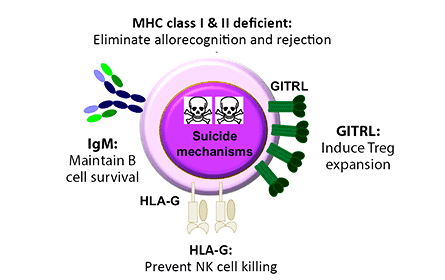
Figure 3: Strategy to generate a BDL-based universal adoptive cell therapy (ACT). To prevent allorecognition and rejection, expression of MHC class I and II molecules will be eliminated. To prevent NK killing of the MHC class II- cells, HLA-G will be expressed. To maintain survival of the ACT, an IgM+ parent cell will be selected. Overexpression of GITRL will promote Treg expansion. Redundant suicide mechanisms will be introduced to control the number of the BDL ACT after administration to patients.

Myeloperoxidase (MPO)

MPO is a myeloid-lineage restricted enzyme that utilizes H2O2 to generate hypochlorous acid that has strong antibacterial properties. In sterile inflammation, such as MS, MPO and MPO-derived oxidants are thought to be pathogenic promoting inflammation and causing tissue damage. In particular, MPO has been implicated in vascular permeability. In MS, the opening of the blood-brain barrier (BBB) is considered detrimental. The presence of MPO within inflammatory lesions in MS patients along with our studies in the EAE model, suggests that it plays a pathogenic role in MS. Using a novel inhibitor of MPO, we have found that its inhibition during EAE rapidly attenuates disease severity that is associated with sealing of the BBB. Current studies in the lab are focused on the pathogenic role of MPO in inflammation with an emphasis on vascular permeability. In addition to EAE, these studies also utilize the contact hypersensitivity and DSS-colitis models in which permeability is also considered pathogenic. The goal of this research is to undercover the mechanism whereby MPO induces vascular and epithelial permeability and to determine whether MPO is a viable therapeutic target for the treatment of inflammatory diseases.

Microbiome

It is now clear that interactions between the immune system and microbiome have consequences for human health. In past studies, we utilized microbiome analysis to study microbial dysbiosis in the gut in IL-10-deficient mice. In current studies, we are utilizing this knowledge and expertise to determine how

Post-doc opportunities are available to work on BDL focused projects. To express interest please contact Dr. Dittel at bdittel@versiti.org

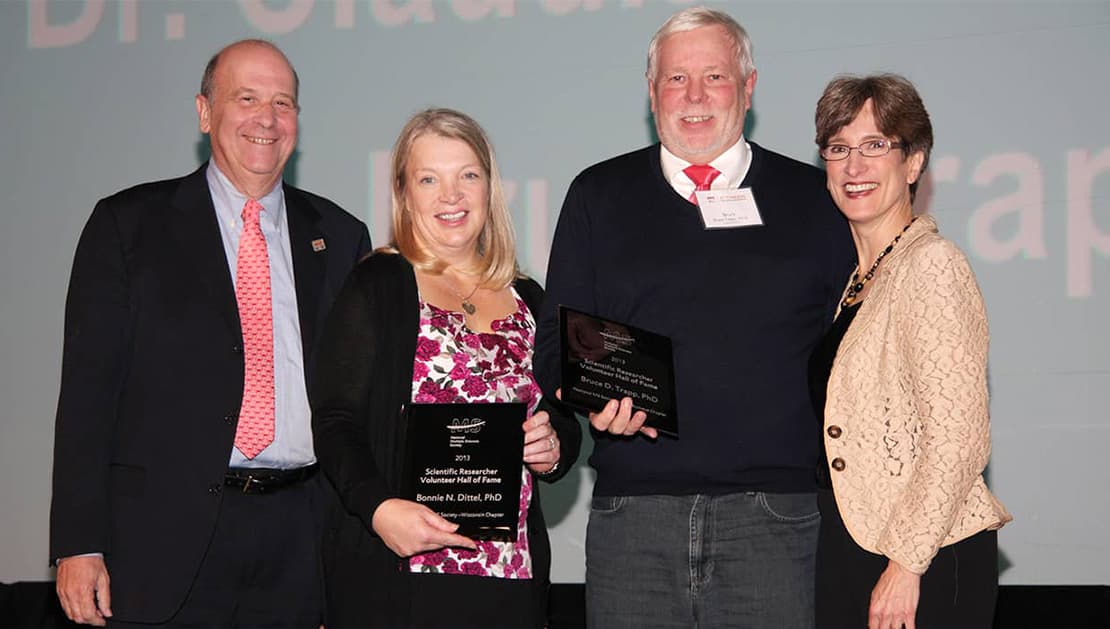
Dr. Dittel receiving an award from the MS Society.

National Multiple Sclerosis Society

NIH Director's Transformational Research Award

Grant Support

2019-2021

R21AI145323, NIAID
A novel human regulatory B cell subset
Principal Investigator

2020-2021

Neuroscience Research Center Imagine More, Medical College of Wisconsin
Dynamics of B cell subtypes in multiple sclerosis before and after treatment
Co-investigator

2019-2022

RG-1901-33315, National Multiple Sclerosis Society
B Cell Regulation in EAE/MS
Principal Investigator

2020-2025

R01AI160244-01, NIAID- NIH Director’s Transformative Research Award
Development of a B cell therapeutic
Principal Investigator

  • 1R56AI122655 - 01A1, NIAID, Mechanisms of a novel regulatory B cell subset  
  • 1R56AI129348-01A1, NIAID, B cell-mediated immune regulation
  • Teva Investigator Sponsored Studies, Teva Pharmaceuticals, Access the ability of Copaxone to enhance the regulatory activity of a novel B cell subset
  • RG 1501-03034, National Multiple Sclerosis Society, Characterization of a Novel Regulatory B Cell Subset that Attenuates EAE
  • Medical College of Wisconsin, Cancer Center pilot grant, Can chronic lymphocytic leukemia (CLL) exhibit regulatory B cell function?

Lab Team

Nathan Meinhardt, PhD

Nathan Meinhardt, PhD

Postdoc Fellow

Identification of human BDL and understanding their development.

Nate is from the Milwaukee area and earned a B.S. degree from Saint Louis University and an M.S. degree from the University of Wisconsin-Milwaukee.

In Dr. Dittel’s lab, he studies the developmental status of BDL and uses cutting-edge tools including scRNAseq to identify them in humans. In his free time, he enjoys skiing, shooting pool and cooking.

Cody Gurski

Cody Gurski

Senior Research Technologist, Lab Manager

Changes in immune cell subsets in multiple sclerosis in response to B cell depletion therapies.

Cody is from the Milwaukee area and earned his B.S. degree in microbiology from the University of Wisconsin-Milwaukee.

Cody serves as the Dittel lab manager, as well as conducting independent research. He is the linchpin of the lab. Outside of the lab, he enjoys music and plays guitar, bass, drums and piano. He also likes to backpack, hike and fish.

Kelli Cole
Graduate Student

Tanya Kozlik
Graduate Student

Publications

Regulatory B cells

Myeloperoxidase

Microbiome

Published Datasets

16S microbiome in IL-10-deficient mice versus wild-type mice

Ray, A., S. Basu, R.Z. Gharaibeh, L.C. Cook, R. Kumar, E.J. Lefkowitz, C.R. Walker, C.D. Morrow, C.L. Franklin, T.L. Geiger, N.H. Salzman, A.F. Fodor and B.N. Dittel. 2015.

Gut microbioal dysbiosis due to Helicobacter drives and increase in marginal zone B cell in the absence of IL-10 signaling in macrophages. J. Immunol.  195:3071-3085.

The metagenomes presented in this article have been submitted to the MG-RAST
Metagenomics Analysis Server (http://metagenomics.anl.gov/linkin.cgi?project=14383)
under MG-RAST identification numbers 4643675.3–4643710.3.


RNAseq in splenic follicular, marginal zone and BDL B cell subsets

Ray, A., Khalil, M., Pulakanti, K.L., Burns, R.T., Gurski, C.J., Basu, S., Wang, D., Rao, S. and Dittel, B.N. 2019.

Mature IgDlow/- B cells maintain tolerance by promoting regulatory T cell homeostasis. Nat. Commun. doi.org/10.1038/s41467-018-08122-9

The RNA-seq data have been deposited in the Gene Expression Omnibus under the accession code GSE111911 and went public December 3, 2018 (https://www.ncbi.nlm.nih.gov/geo/query/acc.cgi?acc=GSE111911).

Protocols

Awards and Patents

Bonnie Dittel accepting the Volunteer Hall of Fame award.

Bonnie Dittel PhD, was nominated to the National Multiple Sclerosis Volunteer Hall of Fame for her laboratory's role in researching the connection between inflammation and diseases like multiple sclerosis.

Awards

Local

  • Outstanding Graduate School Educator for academic year 2016-2017, Medical College of Wisconsin
  • Certificate of Appreciation, Versiti Diversity & Inclusion Council, in honor of Women’s History Month 2020
  • NIH Director’s Transformative Research Award, 2020

National Multiple Sclerosis Society

  • Inducted into the National Multiple Sclerosis Society’s 2012 Volunteer Hall of Fame - Scientific Researcher
  • Stephen C. Reingold Award, National Multiple Sclerosis Society, 2016 Research Partner of the Year 2019, National Multiple Sclerosis Society

Patents

US20100021428A1

  • “Use of Gelsolin to treat multiple sclerosis and to diagnose neurologic diseases.”
  • Inventors: Thomas Stossel, Po-Shun Lee, Bonnie Dittel and Katarzyna Maresz
  • Date of Patent: May 14, 2013